
The Cathedral of San Donato: the Cathedral of Arezzo
The Cathedral of San Donato in Arezzo, also known as the Cathedral of Saints Peter and Donato, is an architectural and spiritual jewel that dominates the city from the top of a hill. Its history is rooted in Roman times and intertwined with that of the martyred saints. With a neoclassical façade redone in the early 1900s and an interior that encompasses centuries of art and devotion, the cathedral stands as a time capsule. Inside, the three naves and works of art, including those by Guillaume de Marcillat and Giorgio Vasari, tell stories of faith and beauty. A unique feature is the Ark of San Donato, which holds the remains of the city's patron saint. To visit it is to take a journey through the history, art and spirituality of Arezzo.
The Cathedral of San Donato in Arezzo, has always been considered the most significant religious site in the city and not only because it houses the bishop’s seat. Also known as the Cathedral of Saints Peter and Donato it is located on the top of a hill where, stood an earlier early Christian church certainly located where the Roman acropolis stood.

Duomo Di San Donato Arezzo
Although the city’s first cathedral rose on Pionta Hill exactly where the remains of the martyr Donatus, executed in 363 A.D., rested, it was Pope Innocent the Third who wanted the cathedral to reside within the city walls. The year was 1203, but the Cathedral of San Donato in Arezzo did not begin to be built until the late 13th century and was not finished until the early 16th century after many rounds of work.
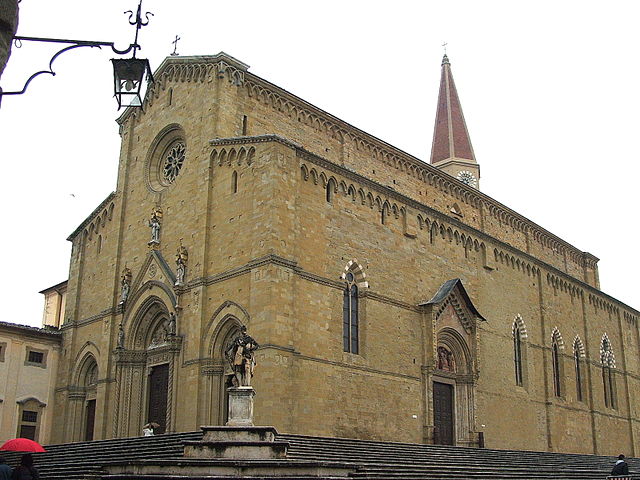
The last remake of the facade was carried out between 1901 and 1914 to a design by Viviani to replace the never-finished one that dated back to the fifteenth century.
Duomo Di San Donato Arezzo: Features
The neoclassical facade is characterized by varied sculptural decoration that enhances the salient elevation followed by the profile of the three naves. The lower part contains three splayed portals decorated with a bas-relief lunette. Note the ghimberga dominated by three statues each protected by its own canopy that are placed only in the central portal, which, in the direction of the main nave, also houses a circular rose window.
The building retains its original structure dating back to the 14th century made of sandstone blocks, and on the right side is a mighty Florentine portal framed by two porphyry columns once used in a pagan temple.
The existing bell tower is the third built for the cathedral. Initially, in fact, the keep was joined to the church but the vibrations generated by the sound of the bells ruined the marvelous stained glass windows by Guillaume de Marcillat that forced the architects to build a second bell tower further away but ignoring the fact that there was a water table underneath that undermined its stability and forced the building of a third ‘edition’ of the bell tower (the one you see today) with a hexagonal plan that was later connected to the cathedral by the construction of a wing dedicated to the guardians’ quarters.
The interior is divided into three naves each divided into six bays with cross vaults and no transept. The round arches, rest on polystyle pillars, and both the nave and right aisle feature circular rose windows that allow light to filter through. The work of Guillaume de Marcillat is the three-and-a-half-foot central pediment depicting Pentecost with the Apostles seated with the Madonna with two angels and the Holy Spirit in the center. Also by De Marcillat are the paintings adorning the upper part of the nave and its vaults.

Duomo Di San Donato Arezzo: The Arcades
The 13th-century polygonal apse is located at the end of the main nave. It is illuminated by three mullioned windows sealed by polychrome stained glass windows that were made after the World War that caused the original ones to be lost.
In the center is the high altar from the late 13th century, and behind it is the Ark of St. Donatus, a marble group dating from before the 14th century and made in homage to St. Donatus bishop patron of Arezzo whose remains rest inside the ark while the head is in a reliquary in the parish churches of Arezzo.
Many artists were involved in the decoration of the Cathedral of San Donato Arezzo: Agostino Di Giovanni, Betto di Francesco, Agnolo di Ventura, Giorgio Vasari to whom we owe the design of the wooden choir of the main chapel.
Suggestive is the 14th-century Gothic-style tomb of Gregory X, which finds space near the first altar by Burali del Torri dating from 1614, and the Tarlati chapel from 1334. Also noteworthy is the Cappella della Madonna del Conforto from the late 18th century that holds a theory of Della Robbia terracotta statues.
In the left aisle is the Baptism of Christ, attributed to Donatello, while Ilariano baptizing San Donato is by Francesco di Simone Ferrucci.
The large painting by Pietro Benvenuti and depicting the Martyrdom of St. Donatus, stands out above the 17th-century altar and before a Renaissance organ by Luca da Cortona that sits on a chancel by Vasari.
Full of character is the cenotaph of Guido Tarlati, the city’s bishop who died in 1327 and placed inside the Chapel of the Blessed Sacrament. Next to the monument, there is also Piero della Francesca’s work depicting Mary Magdalene.
There are many other attractions that deserve attention from visitors who want to step back in time and enjoy the artistic beauties that enrich the Cathedral of San Donato in Arezzo.
Book now your vacation near Arezzo.
Photo credits:
1) Arezzo Cathedral / Cathedral of San Donato => Hideyuki KAMON
2) ark of san donato => Maria